Alphabet Tracing: A Font for Foundational Learning
Beyond Basic Blocks: Understanding the Alphabet Tracing Typeface
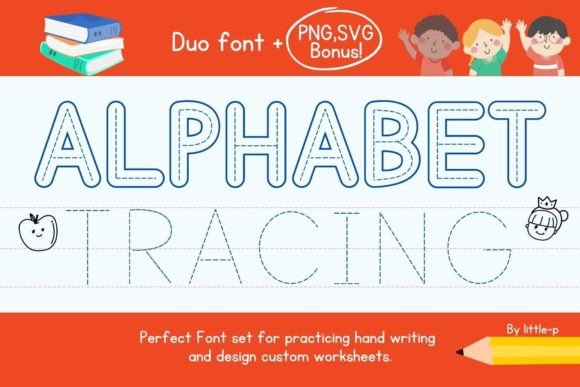
When we talk about essential design assets for education, we often overlook the most fundamental tool: the letterform itself. Alphabet Tracing is a specialized typeface designed not just for reading, but for the physical act of learning to write. Unlike a standard serif font or sans serif font used for body copy, this typeface has a distinct personality rooted in pedagogy. Its visual characteristics are deliberately simple, featuring clean, uncomplicated strokes and generous, consistent proportions. There’s no unnecessary flourish or stylistic complexity here. The style is one of clarity and approachability, aiming to reduce cognitive load for young learners. It feels supportive and structured, providing a clear path for a pencil to follow. This isn't a display font shouting for attention; it's a quiet, reliable guide, making it a uniquely purposeful addition to any educator's or parent's toolkit of design assets.
Practical Applications for Educators and Content Creators
The true value of Alphabet Tracing lies in its direct, real-world applications. For teachers and homeschooling parents, it’s the perfect foundation for creating custom worksheets, tracing cards, and letter recognition activities. Imagine designing a personalized name-writing practice sheet or a set of flashcards where the dotted letters are perfectly calibrated for a child's motor skills. This font transforms the creation of these materials from a chore into a simple, effective process.
Beyond the classroom, its utility extends into the broader realm of content creation and publishing. A children's book author could use it for interactive elements within a story, or a blogger focusing on early childhood education could use it to create downloadable printables for their audience. For crafters and hobbyists, it’s ideal for designing stencils for wood signs, vinyl decals for learning spaces, or templates for embroidery patterns focused on the alphabet. Its clean lines ensure it works beautifully in both digital and print formats, from a PDF worksheet on a tablet to a laser-cut wooden letter.
Integrating a Learning Font into Modern Projects
While its primary audience is educators, a creative professional can find innovative uses for Alphabet Tracing. A brand identity for a tutoring service, a educational app, or a children's stationery line could incorporate this font for specific headings or accents to immediately communicate its educational focus. In web design, it could be used for interactive learning modules or as a stylistic element on a parenting blog to create a sense of hands-on learning. The key is to use it intentionally. It works best as a supporting typeface—a specialist in its niche—rather than the primary font for all text. Pair it with a friendly, readable modern typography choice for body copy to create a balanced and professional layout.
Choosing and Using Alphabet Tracing Effectively
If you're considering this font for a project, think about its core function. Evaluate whether your project requires a tool for teaching letter formation. Test how it looks at the size you'll be using it, ensuring the tracing paths are clear and not too crowded. Consider the font pairing; it harmonizes well with simple, rounded handwritten fonts or clean sans serif fonts. Review the included character set—does it have the punctuation and numerals you need for your worksheets? Finally, check the licensing. While many educational fonts are available for commercial use, always confirm the terms to ensure your use case, whether for a free blog resource or a product you sell, is covered. Alphabet Tracing is more than just a premium font; it's a targeted solution that, when used thoughtfully, can significantly enhance the learning experience and bring a professional touch to educational materials.
As a special resource to complement your learning materials, a free bonus SVG and PNG picture is available to help remember the alphabets. This graphic can be used for coloring activities, offering another engaging way for students to interact with and memorize letter shapes, further supporting the foundational skills that the Alphabet Tracing font is designed to build.